EWOSA News - April 2026
- Home
- EWOSA News - April 2026
From the Ombudsman
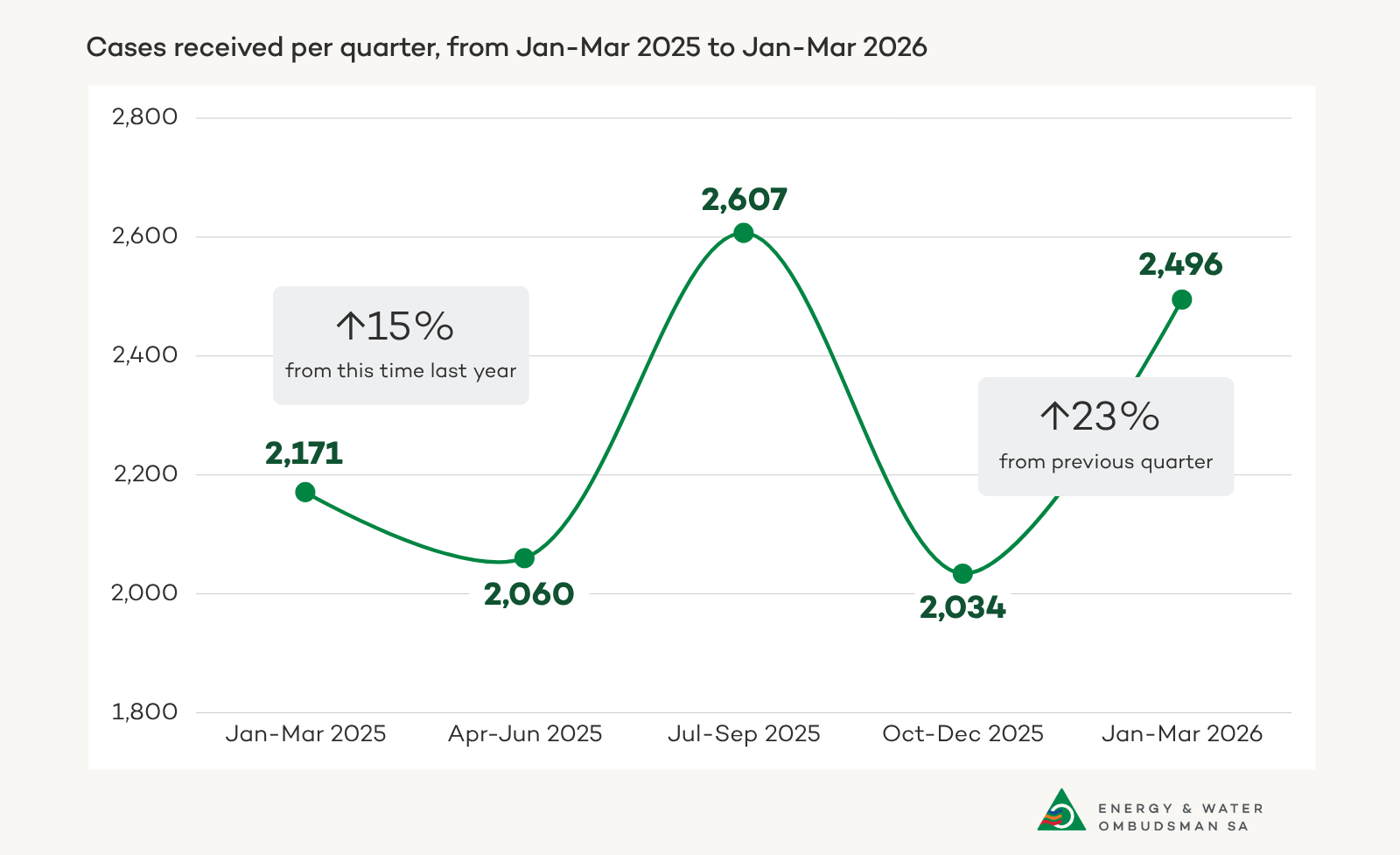
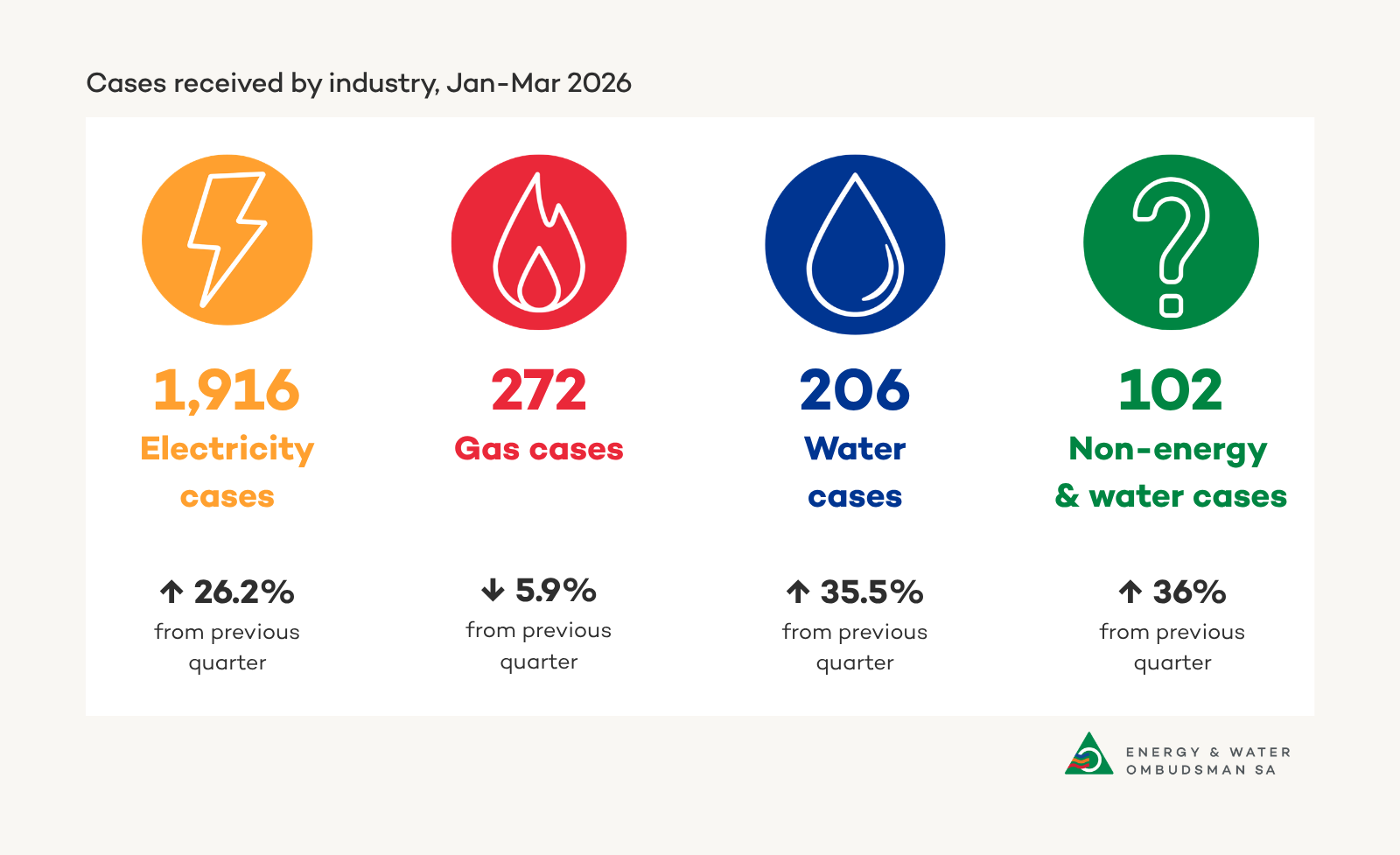
The first few months of the year have been busy for our office. We received almost 2,500 cases in the March 2026 quarter – a 15% increase compared to the same time last year. Complaints about high bills made up 18% of cases, remaining a key driver across electricity, gas and water.
In March, the Australian Energy Regulator (AER) released draft Default Market Offer (DMO) electricity prices for 2026-27. The draft proposes a 1.3% decrease in annual electricity bills for residential customers in South Australia and a 15.2% decrease for small business customers.
For the first time, the DMO will also regulate tariff rates, not just annual costs. Along with the introduction of a Solar Sharer Offer, this represents a step toward ensuring the DMO remains fit for purpose in a market increasingly shaped by rooftop solar, smart meters and time-of-use tariff structures.
As the energy transition accelerates, EWOSA and our interstate counterparts are helping to shape policy to support robust and equitable outcomes. In April, the Australian Energy Market Commission (AEMC) made a final rule on customer-initiated gas abolishments, requiring customers who exit the gas network to pay the full cost of the abolishment service. This is intended to reduce the cost burden of maintaining the gas network for customers who remain connected.
Protecting vulnerable customers requires clear and consistent processes for providers. Both the AEMC and the Essential Services Commission of South Australia (ESCOSA) are considering changes to life support protections to improve the accuracy of registers and communication during outages. These reforms are progressing in parallel across jurisdictions, with AEMC rules applying to national retailers and ESCOSA’s to small-scale electricity and water providers in South Australia, including local councils and regional, off-grid or prepayment communities.
Read on for more in the latest edition of EWOSA News.
Sandy Canale
Energy and Water Ombudsman SA
Hot Issues
The AER released the draft DMO prices for 2026-27 in March. The DMO caps the price a retailer can charge a standing offer customer, and also serves as a benchmark for market offers.
Residential electricity prices are proposed to decrease by 1.3% (around $31 annually) in South Australia, while small business prices are expected to decrease by 15.2% (around $845 annually).
Recent changes to the DMO framework mean that in addition to this annual price benchmark, the AER also needs to start setting price caps for common tariff types, including flat rate and time-of-use tariffs, as well as the new Solar Sharer Offer.
These tariff caps set maximum daily supply and usage charges, including across peak and off-peak periods. This allows consumers to compare their current plan with the DMO on a like-for-like basis, depending on the tariff type they are on, rather than relying only on an average annual bill.
The AER expects to release its final decision by 26 May, with new prices taking effect on 1 July. Providers will issue price change notices in June, which can be used to review and compare plans.
The Solar Sharer Offer (SSO) is a new regulated tariff being introduced under the DMO framework for 2026-27. Electricity retailers with more than 1,000 residential customers will be required to offer the SSO from 1 July 2026.
The SSO is a time-of-use tariff that includes a daily 3-hour free electricity period, designed to align with times of high solar generation. In South Australia, this period is proposed to be between 12pm and 3pm. The tariff is intended to encourage demand to shift to these periods, supporting more efficient use of the electricity system.
The SSO may suit customers with a smart meter who can shift some of their energy usage into the designated period. However, customers who cannot change when they use electricity are unlikely to benefit. This is because the costs retailers incur during the free period are recovered through higher usage charges at other times of the day.
The SSO must be actively selected by customers. Retailers must continue to provide a standard standing offer alongside it and are expected to give clear information about how the SSO works and how customers may benefit.
The Australian Energy Market Commission (AEMC) made a final rule in April on customer-initiated gas abolishments. Under the new rule, customers who choose to permanently remove their gas connection will be required to pay the full cost of the abolishment service.
In South Australia, the costs providers can charge for services such as disconnection and abolishment are approved by the Australian Energy Regulator (AER) through access arrangements with Australian Gas Networks.
The requirement for customers to pay cost-reflective charges will apply from 1 July 2031, following the next access arrangement period (2026-2031). The AER is expected to release its final decision on the upcoming access arrangement in May 2026, which will provide further detail on how these services are regulated in the interim.
The rule is intended to ensure that customers who remain connected to the gas network are not required to bear the costs of others exiting. It also introduces new information requirements for retailers and distributors to support customer decision-making. From October 2026 for distributors and January 2027 for retailers, customers must be provided with clearer information about their options to continue using gas, disconnect, or abolish their connection.
Case Studies
Cara* raised a complaint with EWOSA about high electricity bills after a smart meter was installed at her property in August 2025.
She said her bills were around four times higher than before and believed there may be an issue with the new meter. Her provider investigated and advised that the meter was working correctly and the bills were accurate. Cara did not accept this and asked us to investigate.
We arranged for an independent energy assessor to attend the property. The assessor noted a large swimming pool and an older chest freezer, and found it was likely the property was using the amount of electricity shown on the bills. He considered that the increase may have been due to the previous meter under-recording usage. This could not be confirmed, as the original meter had been disposed of and was no longer available for testing.
We also reviewed Cara’s bills. We noted that the “better offer” message on Cara’s bill had been indicating for a while that she could save money on a different plan. We discussed this with Cara, and she chose to switch to a time-of-use tariff, which reduced her subsequent bills.
We also identified that one “better offer” message had not been issued within the required timeframe. Under the Better Bills Guideline, providers must issue a “better offer” message at least once every 100 days. The provider agreed to apply a credit of $450 to reflect the potential savings Cara may have received if she had switched plans earlier.
We shared the findings of the assessment with Cara and provided guidance on how to better understand and manage her energy use. While the outcome was not what she had initially expected, she was satisfied that the issue had been properly investigated and gained a clearer understanding of her household energy use.
*Names have been changed
Customer Corner
Following the release of the final DMO in May, most consumers will receive a price change notification from their provider in June. This notice will show how your current plan compares to the DMO.
Energy providers are also required to inform small customers on their bills if a better offer is available, at least once every 100 days.
If your provider tells you that your current plan is more expensive than the DMO, or that you could save money on another offer, you should contact them to discuss switching plans.
You may also consider comparing offers across providers. The Energy Made Easy website provides an independent comparison tool, or you can contact the AER for assistance on 1300 585 165.
In addition to reviewing your plan, it is important to check if you are eligible for any concessions. Research from the Consumer Policy Research Centre indicates that 38% of eligible households in South Australia do not currently receive this support.
Concessions are administered by Concessions SA for both energy and water. Information is available in our updated Concessions Factsheet.
From 1 July, new rules under the AEMC’s Improving the Application of Concessions to Bills will require energy providers to take specific steps when a customer signs up or switches plans. Providers must:
- provide information about available concessions, rebates and support programs
- ask customers about their eligibility for this assistance
These changes are intended to improve awareness and increase access to concessions for eligible consumers.
Quarterly Trends


Tier 2 Issue |
Cases received |
Percentage of total |
Billing > High |
471 |
18.78% |
General Enquiry > Information general |
295 |
11.81% |
Billing > Error |
262 |
10.49% |
General Enquiry > Out of Jurisdiction |
178 |
7.13% |
Billing > Estimation |
168 |
6.73% |
Provision > Existing Connection |
118 |
4.73% |
Billing > Account |
95 |
3.80% |
Marketing > Contract |
94 |
3.76% |
Billing > Tariff |
81 |
3.24% |
Supply > Off Supply – Unplanned |
71 |
2.84% |
Policy Submissions
Remember, we are here to help
EWOSA facilitates the prompt resolution of complaints between customers of electricity, gas and water services and members of our scheme by providing a free, independent, accessible, fair and informal service to customers.
Call us on 1800 665 565 or submit a complaint via our web form.