EWOSA News - July 2026
- Home
- EWOSA News - July 2026
From the Ombudsman
Winter often brings higher energy bills as households use more heating to keep warm. It is also the time of year when retailers notify customers of annual electricity price changes following the release of the Australian Energy Regulator's (AER) Default Market Offer.
The AER released the 2026–27 Default Market Offer in late May. This year, the annual bill cap for South Australian residential customers increased by 1.4% for flat-rate tariffs and fell by 1.1% for time-of-use tariffs. For the first time, the AER also set separate caps for daily supply and usage charges. This changed the way standing offer tariffs are structured and, as retailers implemented the new framework, many customers saw higher daily supply charges alongside lower usage charges.
As retailers have begun notifying customers of these changes, we've seen a noticeable increase in enquiries about rising daily supply charges. While prices themselves are outside EWOSA's jurisdiction, we encourage consumers to contact their retailer to discuss available plans or compare offers using the AER's Energy Made Easy website.
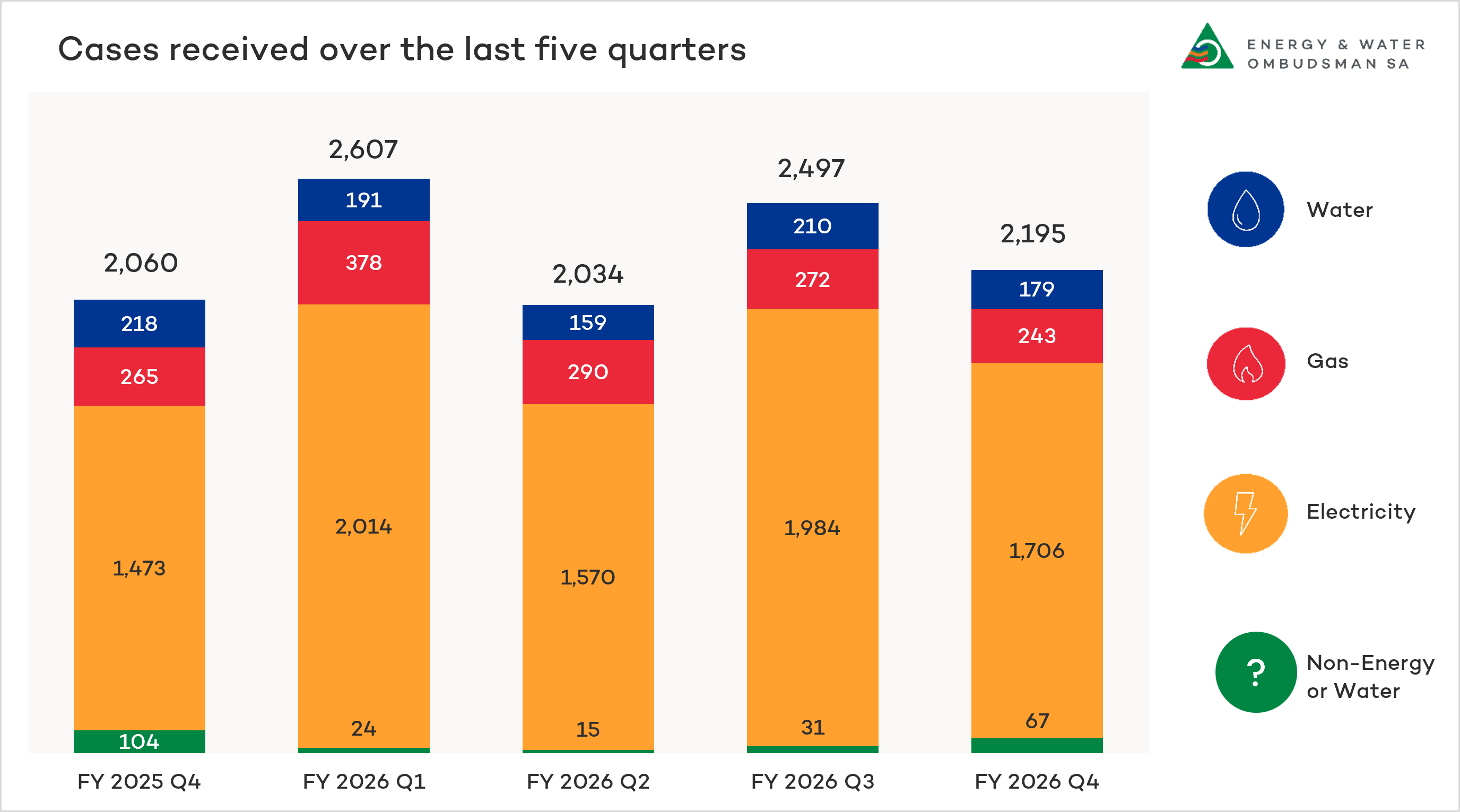
During the April-June quarter, EWOSA received almost 2,200 cases, 7% more than the same period last year. High bills, billing errors and estimated bills remained our most common complaint categories, together accounting for around 30% of all cases.
There has been a flurry of activity in recent weeks from energy market agencies. This edition of EWOSA News covers the Australian Energy Market Commission's (AEMC) Electricity Pricing Review, new life support protections, the AER’s draft Retail Guidelines, proposed payment difficulty reforms and a range of customer protection changes that commenced on 1 July.
I hope you enjoy this edition of EWOSA News.
Sandy Canale
Energy and Water Ombudsman SA
Hot Issues
Since May 2025, the Australian Energy Regulator (AER) has been reviewing the guidelines that shape many of the interactions customers have with their energy retailer, including comparing plans, understanding bills, receiving benefit change notices and accessing payment difficulty assistance.
On 5 June 2026, the AER released draft Retail Guidelines that would combine four existing guidelines into a single document:
- Benefit Change Notice Guideline
- Better Bills Guideline (to be renamed the Billing Guideline)
- Customer Hardship Policy Guideline
- Retail Pricing Information Guideline
The proposed changes are intended to make retailers' obligations easier to understand, supporting more consistent customer communications and better customer experiences.
Overall, the draft guidelines signal a shift away from highly prescriptive communication requirements towards a more principles-based approach. While detailed requirements would remain for billing and customer hardship, the draft introduces a new overarching principle that would require retailers to communicate in a way that is honest and fair.
If adopted, these changes could have broader implications for our Scheme, with complaints about retailer communications assessed against overarching principles rather than prescriptive requirements.
On 18 June 2026, the Australian Energy Market Commission (AEMC) released a Draft Determination and Consultation Paper as part of its review of payment difficulty protections under the National Energy Retail Rules (NERR).
Together, the proposed reforms aim to strengthen protections for customers experiencing payment difficulty while simplifying some existing requirements for retailers.
The Draft Determination proposes changes to:
- clarify when a customer is considered disconnected
- require retailers to contact customers at risk of disconnection through at least two communication channels
- extend the Minimum Disconnection Amount to all customers
- streamline eligibility categories for payment difficulty assistance
- improve information about payment difficulty assistance on retailer websites and notices.
The Consultation Paper also seeks feedback on further reforms, including preventing retailers from requiring documentary evidence before providing payment difficulty assistance, and strengthening payment plan requirements by ensuring they better reflect a customer's capacity to pay and changing circumstances.
Consultation on both proposals closes on 30 July.
The AEMC, Australia's independent energy market rule maker, has released the final report from its Electricity Pricing Review. The review sets out a long-term roadmap for how electricity pricing could evolve to better reflect a modern energy system, where more households are generating, storing and managing their own electricity.
Rather than recommending immediate rule changes, the report identifies four priority reforms:
- increasing transparency around retailer practices that lead to poor outcomes for loyal customers
- making it easier for consumers to compare electricity plans and services
- simplifying energy plans by shifting pricing complexity away from customers and onto retailers
- regularly reviewing customer outcomes to ensure regulation remains effective and fit for purpose.
The AEMC emphasises that these are recommendations only and that any reforms would be introduced gradually through future consultation with governments, industry and consumer groups.
The report also highlights the importance of maintaining strong consumer protections as Australia's energy market continues to evolve.
Within days of each other, the AEMC and Essential Services Commission of South Australia (ESCOSA) finalised changes to life support processes and protections. The AEMC's rule changes apply to National Energy Market (NEM) retailers, excluding Victoria, and take effect from 1 December 2027. while ESCOSA's changes apply to South Australia's small-scale electricity and gas providers and SA Water and take effect from 1 July 2026, with full compliance expected from 1 July 2027.
Although the two reforms apply to different sectors, they take a similar approach and move towards more consistent protections for customers who rely on life support equipment, regardless of who provides their energy or water services.
Key changes include:
- making retailers responsible for registering and deregistering life support customers
- requiring retailers to confirm customers' life support details each year
- allowing customers to nominate a secondary contact
- removing limits on customers re-registering without medical confirmation
- improving protections for customers in embedded networks by requiring retailers to notify the embedded network operator when a life support customer registers, helping ensure the appropriate outage notifications and protections are applied.
Case Studies
Barry* received a text message from a metering service provider (MSP) in early January 2026 advising that his basic meter would be replaced with a smart meter the following day. He was upset because he had not received any prior notification from his electricity provider about the planned upgrade.
Barry immediately contacted his provider to express his frustration about the lack of notice. He explained that he did not want a smart meter, citing concerns about potential tariff changes and privacy. He asked for the meter exchange to be cancelled.
During the call, the provider’s representative told Barry that the exchange would be cancelled and that he could opt out of having his basic meter replaced by a smart meter.
However, this information was incorrect. The Australian Energy Market Commission (AEMC) introduced rule changes requiring smart meters to be rolled out to all residential and small business customers by the end of 2030. As part of these changes, customers can no longer opt out of a smart meter upgrade.
Despite being assured that the replacement would not proceed, Barry discovered the next day that the MSP had attended his property and installed a smart meter.
Barry then brought his complaint to EWOSA. His provider had told him written notice of the meter exchange was sent to him by email in late December 2025. However, Barry had no record of receiving the email and asked EWOSA to investigate whether the required notice had been provided within the prescribed timeframe.
Under the NERR, when a customer's meter is to be replaced with a smart meter, the retailer must provide written notice no earlier than 60 business days and no later than four business days before the proposed replacement date.
As part of our investigation, we asked the provider to supply evidence that the notice had been issued. The provider maintained that it had complied with its obligations because its contracted MSP had sent the notice by email in late December 2025. The provider supplied a copy of the notice itself and a screenshot from the MSP's system indicating that the notice had been sent. However, it was unable to provide a copy of the email that was allegedly sent to Barry.
We also reviewed the telephone call between Barry and his provider. During the call, the provider's representative incorrectly advised Barry that he could opt out of the smart meter exchange and that the planned replacement would be cancelled.
In recognition of the issues identified during our investigation, particularly the poor customer service and incorrect information provided to Barry, the provider agreed to apply a $500 credit to his account.
This case highlights the importance of ensuring customer-facing staff are well informed about smart meter rollout requirements. It also demonstrates how effective coordination between retailers and metering service providers can significantly influence customer outcomes and experiences.
*Names have been changed
Customer Corner
Understanding the energy market can be challenging, particularly for people who prefer to access information in a language other than English. To help make energy information more accessible, the Australian Government has published a range of multilingual resources in more than 40 languages.
The resources cover:
- ways to save energy and money at home
- saving energy and water in rental properties
- support for customers experiencing difficulty paying their electricity or gas bills.
EWOSA also provides brochures about our complaints process in a number of languages.
A range of new or improved customer protections came into effect on 1 July 2026, strengthening safeguards for customers and introducing new obligations for energy retailers.
The changes include:
- limiting price increases on market retail contracts to once every 12 months
- ensuring customers whose contract benefits expire do not pay more than the standing offer
- removing unreasonable conditional discounts for customers on existing market contracts
- strengthening protections for vulnerable customers (those experiencing payment difficulty or family violence) by restricting certain fees
- requiring retailers to provide information about relevant concessions, rebates and relief schemes, and ask customers about their eligibility when entering into a new contract
- increasing the Minimum Disconnection Amount from $300 to $500
- protecting carry-over customers on deemed retail arrangements from disconnection while they continue paying their bills.
Additional protections have also been introduced for customers in embedded networks. From 1 July, residential customers will see EWOSA's contact details on their electricity bills, and embedded network operators must publish their tariffs on their websites, alongside a comparison with the local area retailer's standing offer.
Quarterly Trends


Tier 2 Issue |
Cases received |
Percentage of total |
General Enquiry > Information general |
333 |
15% |
High > Billing |
281 |
13% |
Error > Billing |
249 |
11% |
Estimation > Billing |
149 |
7% |
Out of Jurisdiction > General Enquiry |
144 |
6% |
Failure to respond / Inform > Customer Service |
117 |
5% |
Account > Billing |
116 |
5% |
Existing Connection > Provision |
99 |
4% |
Tariff > Billing |
69 |
3% |
Fees and Charges > Billing |
67 |
3% |
Policy Submissions
Remember, we are here to help
EWOSA facilitates the prompt resolution of complaints between customers of electricity, gas and water services and members of our scheme by providing a free, independent, accessible, fair and informal service to customers.
Call us on 1800 665 565 or submit a complaint via our web form.